
From Stanford to Marketing Intelligence: How We Build AI Focus Groupsمن Stanford إلى Marketing Intelligence: إزاي بنبني AI Focus Groups في Monzology
We took the generative-agent architecture published by Stanford and Google Research and re-engineered it into an AI Focus Group layer inside our marketing work — independent personas, mandatory objections, counts instead of percentages, and an honest account of where the limits are.أخدنا معمارية الـgenerative agents اللي نشرتها Stanford وGoogle Research وأعدنا هندستها كطبقة AI Focus Group جوّه شغل الماركتنج — Personas مستقلة، اعتراض إجباري، أعداد بدل النِسَب، وكلام صريح عن حدود اللي إحنا فيه.
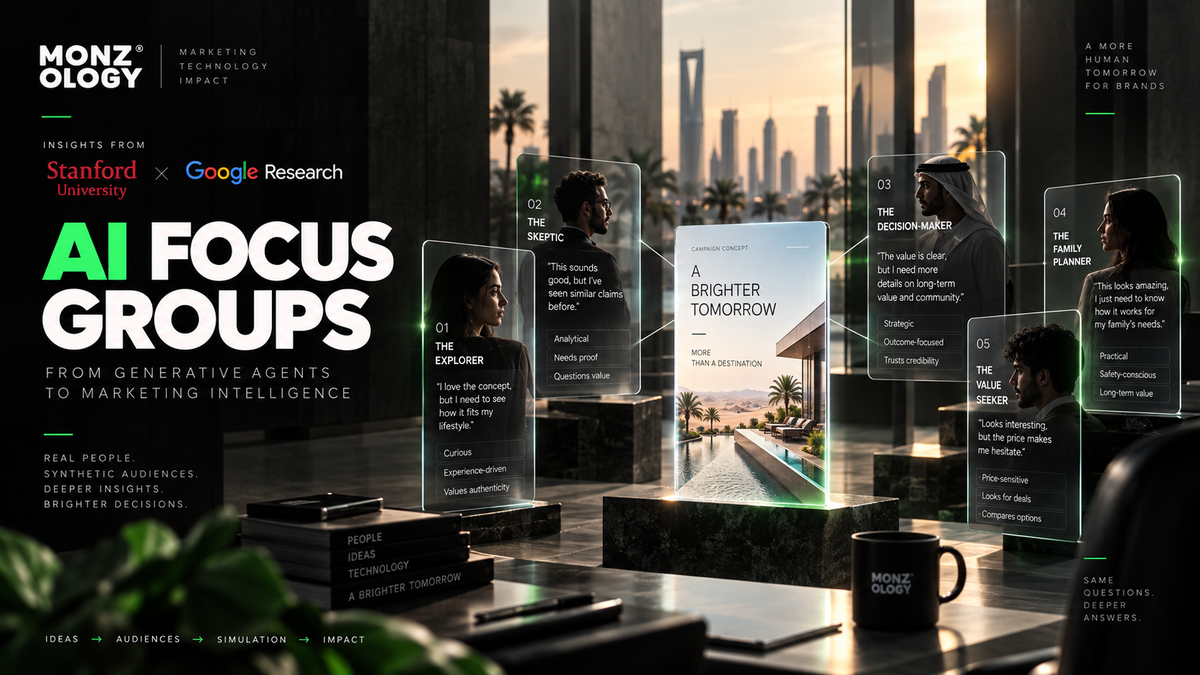
At Monzology we do not use AI just to write copy faster or hand you twenty ad ideas before lunch. We build AI-powered marketing systems that can sit inside bigger decisions:
- Will this positioning work in a market we have not entered yet?
- Will this message build trust, or plant doubt?
- Will this price read as attractive, or quietly lower the perceived value?
- Does the same campaign really travel from Egypt to Saudi Arabia unchanged?
That is how we ended up building AI Focus Groups. But instead of writing a prompt that tells a language model to "act like five customers", we started from deeper research into generative agents, and engineered an approach on top of it that fits the way marketing work actually runs.
It started with Generative Agents
In 2023, a team from Stanford and Google Research published Generative Agents: Interactive Simulacra of Human Behavior — software agents that simulate aspects of human behaviour convincingly enough to be studied.
The part that caught us was not that the AI "plays a person". It was the architecture. The agent keeps a record of its experiences in natural language, reflects on them to form higher-level conclusions, and retrieves what is relevant when it has to decide or act.
In other words: memory, reflection, retrieval, planning, behaviour — which is a very different thing from prompt, answer.
For us that was a starting point. Not so we could take finished technology and put a logo on it, but so we could ask a better question: what happens if you take the logic of generative agents and turn it into an intelligence layer inside the marketing process?
From agent to AI Focus Group
Picture a brand preparing a major launch in Riyadh. Before the heavy spend starts — creative production, media, influencers, activations, landing experiences — there is one question worth answering: is the proposition itself understood and convincing to the different segments we are targeting?
That is where an AI Focus Group can enter, as an early layer in the decision process.
We define a set of audience profiles. Each persona carries a context, motivations, pain points, buying behaviour, objections and language. Then we put the proposition in front of them.
Not one persona speaking on behalf of the group. Each persona gets its own independent interaction — and that is an engineering distinction, not a cosmetic one.
We are not looking for the AI that says "nice"
This is one of the biggest problems with using LLMs in marketing. The model wants to be helpful. Show it your campaign and ask what it thinks, and you get: the idea is strong, the message is clear, maybe tighten the CTA.
Thank you. That is not a focus group. That is AI being polite.
So we design the interaction around the objection. The persona is not only asked to judge the idea. It is asked to explain what is making it hesitate — and then what would have to change for it to agree.
That changes the nature of the output. Instead of "the campaign is not convincing", you move toward "the campaign is not convincing because the value is not clear to me". And the next question becomes: what piece of information, if it changed, would change the decision?
For a marketer, that is actionable.
What the newer research adds
Here it gets more interesting. In a more recent study, Stanford-led researchers working with collaborators at other institutions built agents to simulate 1,052 real people, using different sources of information about them.
They compared how the agents were grounded. Agents built from interviews with real people reached 83%. Agents built from structured surveys reached 82%. Combining both reached 86%. Agents built from demographic descriptions alone reached 74%.
Those numbers have to be read correctly. They are not absolute accuracy. They are measured against how consistent a human being is when asked the same questions again two weeks later. The human participant is the benchmark.
And that matters to us more than the number itself, because of what it says plainly: the more real information you have about a person, the better a simulation can represent them.
And this is the part that changed how we talk about it
Our AI Focus Group is not currently built on real interviews with real customers. We build personas from what the marketer defines: age, city, role, behaviour, pain points, objections, language.
So, honestly: we are closer to the 74% condition. Not 83%. Not 86%.
And we are not going to use the research numbers as if they were Monzology's accuracy, because that is not what the research said. That discipline is exactly what turning research into commercial technology requires.
So what is it worth, knowing the limits?
The value is not that the AI decides for you. The value is that it widens the range of questions you can ask before a decision reaches the market.
A brand entering a new market
A company moves into a Gulf market with brand messaging that was originally built for a different one. The focus group can surface that the problem is not the creative at all — it is language, cultural context, perceived relevance, trust. That sends the team back to positioning before the problem shows up as campaign performance.
A premium proposition
A brand launches something premium. The team believes the price and the language communicate exclusivity. A second persona may read the same signal as overpriced. A third asks: what am I actually getting for this price? The focus group does not pick the winner. It exposes the difference in interpretation.
Banking
A bank is preparing a proposition for affluent customers. The question is not "is the ad beautiful". It is whether the message builds trust, whether it speaks the customer's language, whether the benefit is clear, and whether there is an objection hiding in privacy, complexity or the cost of switching. The focus group can build that layer of questions and objections before the campaign meets the market.
Telecom
An operator launches a proposition aimed at a particular segment. The same offer can be attractive to a price-sensitive customer and irrelevant to one who is buying convenience or premium service. Instead of treating "the audience" as one block, you break it into positions.
Real estate
A developer prepares a large launch. The decision is not whether the headline is nice. Is the value proposition understood? Is the location read as an advantage? Is the pricing signal right? Is the lifestyle promise believable? What is the first objection? And who in the audience rejects the premise the campaign is built on in the first place?
These are questions an AI Focus Group can start to take apart before market validation.
We build the system to disagree
We do not like AI that returns a nice-looking answer and stops. So the system carries constraints.
Each persona interacts independently. Objections are a mandatory part of the output. The scale is positive / reserved / negative / undefined rather than good / bad. A persona that fails to answer returns a failure, not an invented answer. And when the sample is small we report counts, not percentages.
If two out of three personas rejected it, we say 2 of 3. Not 67% of the market. We are building a decision-support system, not a machine for manufacturing scientific-looking numbers.
This is not an isolated SaaS product
The AI Focus Group is part of something bigger. At Monzology we build AI-powered marketing systems, which means AI enters at different stages of the work: research, intelligence, strategy, audience, creative, content, testing, optimisation.
The focus group can be a layer inside that system. Not to replace the marketer, and not to replace research — but to add another layer of intelligence before the decision reaches the market.
And there is still something we have to prove
The virtual focus group is built and running. But we are not putting it in front of clients as a standalone product yet.
Before we do, we need to calibrate it against three to five real campaigns whose actual results we already know. Simulation against reality. Where was it right? Where was it wrong? Where was the persona description too thin? And where did the system need real evidence instead of a profile?
After that we can decide what deserves to become a wider commercial capability.
Because to us, AI is not impressive for looking clever
The technology we work on is not a new way to write content. It is a new way to build decision layers around marketing.
We started from research into generative agents. We took an architecture and a set of ideas from it. We re-engineered them inside a marketing environment. And we use them as part of how Monzology builds AI-powered marketing services.
Published research
Stanford and Google Research published the generative-agent architecture in 2023, and a Stanford-led team published the 1,052-person simulation study in 2024. That is the source of the idea and the evidence about its limits — it is not our technology, and we do not present it as ours.
Monzology engineering
We took the architecture and re-engineered it for a marketing environment: independent persona runs, a mandatory objection, a fixed verdict scale, counts instead of percentages, and a follow-up sequence that ends in a change list.
Commercial application
Used as an early decision layer on real marketing questions — market entry, premium positioning, trust in financial services, segmentation in telecom, the promise behind a property launch.
The AI Focus Group is one example. But the bigger question for us is this: what happens when we stop using AI only to produce marketing, and start using it to test our own thinking before we produce anything at all?
That, to us, is where real Marketing Intelligence starts.
Generative Agents: Interactive Simulacra of Human Behavior
Park, O'Brien, Cai, Ringel Morris, Liang, Bernstein — research.google/pubs
LLM Agents Grounded in Self-Reports Enable General-Purpose Simulation of Individuals
1,052 participants. Originally published as "Generative Agent Simulations of 1,000 People" — arXiv:2411.10109
في Monzology، إحنا مش بنستخدم الـAI بس عشان يكتب copy أسرع أو يطلعلك 20 فكرة للإعلان. إحنا بنبني AI-powered marketing systems تقدر تدخل في قرارات أكبر:
- هل الـpositioning ده هيشتغل في سوق جديد؟
- هل الرسالة دي هتخلق ثقة ولا شك؟
- هل الـpricing هيبان attractive ولا هيقلّل الـperceived value؟
- هل نفس الـcampaign ينفع لمصر والسعودية بنفس الطريقة؟
وهنا دخلنا في مجال AI Focus Groups. لكن بدل ما نبني Focus Group عبارة عن prompt بيقول للـLLM «مثّل خمس عملاء»، بدأنا من research أعمق في Generative Agents، وبنينا فوقه approach يناسب شغل الـmarketing.
البداية كانت من Generative Agents
في 2023، فريق من Stanford وGoogle Research نشر ورقة بعنوان Generative Agents: Interactive Simulacra of Human Behavior. الفكرة الأساسية كانت بناء software agents تقدر تحاكي جوانب من السلوك البشري بشكل مقنع.
لكن الجزء اللي شدّنا مش إن الـAI «بيمثّل إنسان». الجزء المهم كان المعمارية. الـagent عنده سجلّ للخبرات في شكل طبيعي، بيقدر يعمل منها reflections واستنتاجات أعلى مستوى، وبعدها يسترجع المعلومات المناسبة لما يحتاج يقرّر أو يتصرّف.
بمعنى تاني: Memory ← Reflection ← Retrieval ← Planning ← Behavior. وده مختلف جدًا عن Prompt ← Answer.
بالنسبة لنا، دي كانت نقطة البداية. مش عشان ناخد technology جاهزة ونحطّ عليها logo، لكن عشان نسأل سؤال أحسن: إيه اللي بيحصل لو أخدنا منطق الـgenerative agents وحوّلناه لطبقة intelligence جوّه عملية الـmarketing؟
من Agent إلى AI Focus Group
تخيّل Brand بيستعد لإطلاق كبير في الرياض. قبل ما يبدأ صرف ضخم على creative production وmedia وinfluencers وactivations وlanding experiences، عنده سؤال مهم: هل الـproposition نفسه مفهوم ومقنع للشرايح المختلفة اللي بنستهدفها؟
هنا الـAI Focus Group ممكن يدخل كطبقة مبكرة من الـdecision process.
بنعرّف مجموعة من الـaudience profiles. كل Persona عندها context وmotivations وpain points وbuying behavior وobjections وlanguage. وبعدين نحطّ قدامها الـproposition.
مش Persona واحدة بتتكلم باسم المجموعة. كل Persona ليها interaction مستقلة. وده فرق هندسي مهم، مش شكلي.
إحنا مش بندوّر على الـAI اللي يقول «حلو»
دي واحدة من أكبر مشاكل استخدام LLMs في الـmarketing. الموديل بطبيعته عايز يكون helpful. فلو وريته إعلانك وسألته «إيه رأيك؟» ممكن يرجعلك: الفكرة قوية، الرسالة واضحة، ممكن تحسين الـCTA.
شكرًا. بس ده مش Focus Group. ده AI بيجاملك.
عشان كده بنصمّم الـinteraction حوالين الـobjection. الشخصية مش بس بيتطلب منها تحكم على الفكرة. بيتطلب منها تشرح إيه اللي مخلّيها مترددة، وبعدها إيه اللي لازم يتغيّر عشان توافق.
وده بيغيّر طبيعة الـoutput. بدل «الحملة مش مقنعة»، نبدأ نقرب من «الحملة مش مقنعة لأن القيمة مش واضحة بالنسبة لي». والسؤال اللي بعده بيبقى: إيه المعلومة اللي لو اتغيّرت ممكن تغيّر القرار؟ بالنسبة للـmarketer، دي معلومة قابلة للتنفيذ.
طب فين الـresearch الأحدث؟
هنا الموضوع بقى أكتر إثارة. في دراسة أحدث، قادها باحثون من Stanford بالتعاون مع باحثين من مؤسسات تانية، اتبنى agents لمحاكاة 1,052 شخص حقيقي باستخدام مصادر مختلفة من المعلومات عنهم.
والباحثين قارنوا طرق بناء الـagents. الشخصيات المبنية على مقابلات مع أشخاص حقيقيين وصلت لـ83%. المبنية على استبيانات منظّمة وصلت لـ82%. الجمع بين الاتنين وصل لـ86%. أما المبنية على demographic descriptions بس فوصلت لـ74%.
لكن الأرقام دي لازم تتفهم صح. دي مش absolute accuracy. دي مقارنة بمدى ثبات الإنسان نفسه لما يتسأل تاني بعد أسبوعين. يعني الـhuman participant هو الـbenchmark.
وده بالنسبة لنا أهم من الرقم نفسه، لأنه بيقول حاجة واضحة: كل ما زادت المعلومات الحقيقية عن الشخص، كل ما زادت قدرة الـsimulation على تمثيله.
ودي النقطة اللي فرقت معانا
الـAI Focus Group بتاعنا حاليًا مش مبني على مقابلات حقيقية مع العملاء. إحنا بنبني الـPersonas من المعلومات اللي بيحدّدها الـmarketer: العمر، المدينة، الوظيفة، السلوك، الـpain points، الـobjections، الـlanguage.
يعني بصراحة: إحنا أقرب لحالة الـ74%. مش الـ83%. ومش الـ86%.
ومش هنستخدم أرقام البحث كأنها accuracy بتاعت Monzology، لأن ده مش اللي البحث قاله. وده بالظبط النوع من الـdiscipline اللي بنحتاجه وإحنا بنحوّل research لـcommercial technology.
طب إيه قيمة AI Focus Groups لو إحنا عارفين الحدود دي؟
القيمة مش إن الـAI يقرّر بدالك. القيمة إنه يوسّع مساحة الأسئلة اللي تقدر تسألها قبل ما القرار يدخل السوق.
Brand داخل سوق جديد
شركة بتدخل سوق خليجي برسالة brand اتبنت أصلًا لسوق مختلف. الـAI Focus Group ممكن يكشف إن المشكلة مش في الـcreative نفسه، المشكلة في الـlanguage والـcultural context والـperceived relevance والـtrust. وده يخلّي الفريق يرجع للـpositioning قبل ما المشكلة تظهر في campaign performance.
Premium proposition
Brand بيطلق proposition premium. الـteam شايف إن السعر واللغة بيوصّلوا exclusivity. لكن Persona تانية ممكن تقرا نفس الإشارة على إنها overpriced. وPersona تالتة ممكن تسأل: أنا بالظبط بآخد إيه مقابل السعر ده؟ هنا الـFocus Group مش بيختار الفايز، هو بيكشف الاختلاف في الـinterpretation.
Banking
بنك بيجهّز proposition جديد لعملاء affluent. المشكلة مش «هل الإعلان جميل؟». المشكلة: هل الرسالة تبني trust؟ هل بتتكلم بلغة العميل؟ هل الـbenefit واضح؟ وهل في objection متعلق بالـprivacy أو الـcomplexity أو تكلفة الـswitching؟ الـFocus Group ممكن يبني layer من الأسئلة والاعتراضات قبل دخول الحملة السوق.
Telecom
شركة اتصالات بتقدّم proposition جديد لشريحة معيّنة. نفس العرض ممكن يكون جذّاب لعميل price-sensitive، لكن irrelevant لعميل بيدوّر على convenience أو premium service. وبدل ما نتعامل مع «the audience» كمجموعة واحدة، نقدر نفكّكها لمواقف مختلفة.
Real Estate
Developer بيجهّز launch لمنتج عقاري كبير. هنا القرار مش مجرد «هل الـheadline حلو؟». في أسئلة أكبر: هل الـvalue proposition مفهوم؟ هل الـlocation بيتفهم كميزة؟ هل الـpricing signal مناسب؟ هل الـlifestyle promise believable؟ إيه أول objection ممكن يظهر؟ ومين من الـaudience ممكن يرفض أصلًا الـpremise اللي الحملة مبنية عليه؟
دي أسئلة ممكن نستخدم AI Focus Groups عشان نبدأ نفكّكها قبل الـmarket validation.
والأهم: إحنا بنبني النظام عشان يختلف
في Monzology، إحنا مش بنحب الـAI اللي بيطلعلك إجابة شكلها حلو وخلاص. عشان كده الـsystem عندنا فيه مجموعة constraints.
كل Persona بتتفاعل بشكل مستقل. الـobjections جزء إجباري من الـoutput. والمقياس Positive / Reserved / Negative / Undefined بدل Good / Bad. ولو الـPersona فشلت في الرد، بنسجّل failure بدل ما نخترع إجابة. ولما العيّنة تكون صغيرة، بنقول counts مش percentages.
لو 2 من 3 Personas رفضوا؟ نقول 2 من 3. مش 67% من السوق. لأننا بنبني decision-support system، مش آلة لصناعة أرقام شكلها علمي.
وده مش منتج SaaS معزول
الـAI Focus Group بالنسبة لنا جزء من حاجة أكبر. إحنا في Monzology بنبني AI-powered marketing systems، يعني الـAI بيدخل جوّه مراحل مختلفة من الشغل: research، intelligence، strategy، audience، creative، content، testing، optimization.
والـAI Focus Group ممكن يكون طبقة داخل الـsystem ده. مش عشان يستبدل الـmarketer، ومش عشان يستبدل الـresearch، لكن عشان يضيف layer تانية من الـintelligence قبل ما القرار يوصل السوق.
ولسه عندنا حاجة لازم نثبتها
وده الجزء اللي مش هنحاول نخبّيه. الـVirtual Focus Group مبني وشغّال، لكن لسه مش بنطرحه كمنتج مستقل للعملاء.
قبل ما نعمل كده، إحنا محتاجين نعايره على 3–5 حملات حقيقية إحنا عارفين نتايجها الفعلية. نقارن الـsimulation بالواقع، ونشوف: فين أصاب؟ فين أخطأ؟ فين كان الـPersona description ناقص؟ وفين الـsystem احتاج evidence أكتر؟
بعدها نقدر نقرّر إيه اللي يستاهل يتحوّل لـcapability تجارية أوسع.
لأن بالنسبة لنا، الـAI مش impressive عشان شكله ذكي
الـtechnology اللي بنشتغل عليها مش مجرد طريقة جديدة لكتابة المحتوى. هي طريقة جديدة لبناء decision layers حوالين الـmarketing.
بدأنا من research في generative agents. أخدنا منه architecture وأفكار. أعدنا هندستها داخل بيئة marketing. وبنستخدمها كجزء من الطريقة اللي Monzology بتبني بيها AI-powered marketing services.
بحث منشور
Stanford وGoogle Research نشروا معمارية الـgenerative agents سنة 2023، وفريق بقيادة Stanford نشر دراسة الـ1,052 شخص سنة 2024. ده مصدر الفكرة والدليل على حدودها — مش تكنولوجيا بتاعتنا، ومش بنقدّمها على إنها بتاعتنا.
هندسة Monzology
إحنا خدنا المعمارية وأعدنا هندستها لبيئة الماركتنج: كل Persona في run مستقل، اعتراض إجباري في الـoutput، مقياس أحكام ثابت، أعداد بدل النِسَب، وسلسلة أسئلة متابعة بتنتهي بقائمة تغييرات.
تطبيق تجاري
بنستخدمها كطبقة مبكرة في القرار على أسئلة ماركتنج حقيقية — دخول سوق جديد، positioning premium، الثقة في الخدمات المالية، تقسيم الشرايح في الاتصالات، والوعد ورا إطلاق عقاري.
والـAI Focus Group واحد من الأمثلة. لكن السؤال الأكبر بالنسبة لنا هو: إيه اللي بيحصل لما ما نستخدمش الـAI بس عشان ننتج marketing… لكن نستخدمه عشان نختبر طريقة تفكيرنا قبل ما ننتجها؟
هنا، بالنسبة لنا، بيبدأ الـMarketing Intelligence الحقيقي.
Generative Agents: Interactive Simulacra of Human Behavior
Park, O'Brien, Cai, Ringel Morris, Liang, Bernstein — research.google/pubs
LLM Agents Grounded in Self-Reports Enable General-Purpose Simulation of Individuals
1,052 مشارك. اتنشرت أصلًا باسم "Generative Agent Simulations of 1,000 People" — arXiv:2411.10109